
St. Joseph County Criminal Docket Searches
Indiana MyCase is the official public search for the Odyssey system. Pick Case if you know a cause number, citation, or cross-reference. Pick Name if you only have a party name. Set the court filter to St. Joseph County and choose Criminal & Citation. For Walkerton matters, use the separate St. Joseph County - Walkerton Town Court option instead.
Too broad a name can flood you with matches. MyCase stops at 1,000 results. Narrow things with a first name, a filing-date range, or the court. No account is needed and the search is free. Expect a CAPTCHA now and then. When nothing comes back, check the spelling. Try a wildcard at the end of the name, strip hyphens from the case number, and confirm the court listed on your notice.
- Open MyCase and choose Case or Name.
- Select St. Joseph County or Walkerton Town Court.
- Choose Criminal & Citation, then add status or filing dates.
- Open the match and read the summary and events.
- Ask the filing clerk for file review or a certified copy when needed.
St. Joseph Criminal Search Tools
The official MyCase search tips cover the finer points. Case numbers run with or without hyphens and leading zeros. Wildcards go at the end of a name only. Sounds-like cannot be combined with one. Case mode takes a single key at a time. Name mode handles last, first, and middle names, birth date, or a business, each under its stated rules.
Used together, these controls tell a bad query apart from a St. Joseph County criminal docket that simply is not public.
Criminal Dockets: What They Show
Indiana names the event history a Chronological Case Summary, or CCS. The clerk and court add dated entries to it as each step happens. It is not the whole file, though. Recordings, exhibits, confidential filings, and most papers stay out of the CCS. Some public documents carry a link. Other entries list only a title.
| Case number | A code such as 71D03-2608-F6-000123 showing county, court, filing period, type, and sequence. |
|---|---|
| Charge block | Alleged offense, statute, degree, and noted amendments. |
| Settings | Arraignment, pretrial, motion, trial, sentencing, or review dates. |
| Events | Filings, motions, orders, pleas, judgments, violations, and appeals. |
| Disposition | The recorded result, which must be read apart from the original charge. |
| Financial data | Online amounts may be stale; the clerk controls the current balance. |
Remember that a charge is only an allegation. Later CCS events and the final disposition tell the real story, and bond status says nothing about guilt, dismissal, or sentence.
St. Joseph Criminal Codes Decoded
Cause-number letters mark the case type. Felonies today run F1 through F6, with MR for murder. A misdemeanor is CM. Miscellaneous criminal is MC, and an infraction is IF. Ordinance violations show as OV. Older files may instead carry CF or the retired FA through FD classes.
- CCS
- The court's dated register of case events.
- Setting
- A scheduled event, not always a trial.
- Disposition
- The recorded result for a charge or case.
- Continuance
- A court-approved move to a later date.
- Expungement
- A process that can change public visibility.
Codes point you in the right direction, but the event text and orders carry the fuller meaning. Court staff can explain file access. They cannot give legal advice.
Criminal Case Stages on the Docket
A filing opens the case with a cause number and the first CCS events. The arraignment entry records the first formal appearance and the plea process. Expect pretrial entries next: discovery notices, motions, conferences, bond review, and resets. A plea or trial then leads toward judgment and disposition. Sentencing follows a conviction. Later compliance or violation events come after that.
Docket flow: Filing › Arraignment › Pretrial › Plea or Trial › Disposition › Sentencing
Cases rarely follow one script. One count can be dismissed while the case lives on. An amended charge may replace the original one, and an appeal moves activity into MyCase's appellate records rather than the county trial CCS alone.
St. Joseph Felony Docket Location
Local rules assign felony cases to the Superior Criminal Trial Division. That docket sits at Courthouse 3, 129 S Main Street, South Bend. Courthouse 2 houses the main misdemeanor and traffic clerk. Misdemeanor trials and Traffic Court run at Courthouse 1. The county's Superior Court page explains the eight-judge system.
So get the right court before you call. A felony CCS does not put the file at the misdemeanor counter. Reach the Superior criminal status line at 574-235-5484. The misdemeanor clerk sits at 574-235-9100. The Clerk main line is 574-235-9635. Ask the clerk about counter review of the docket, since no public terminal is posted.
St. Joseph County Criminal Docket Courts
Most criminal work in the county belongs to St. Joseph Superior Court. Felonies, misdemeanors, and traffic cases all land there. Circuit Court plays a narrow part, mainly criminal nonsupport, welfare fraud, and grand-jury proceedings. Probate Court holds separate juvenile jurisdiction. Walkerton Town Court, 71I01, rounds out the picture. It is the one town court.
| Court | Docket focus | Access |
|---|---|---|
| Superior Criminal Trial | Felonies and transferred jury matters | MyCase, filing clerk |
| Superior misdemeanor/traffic | Misdemeanors and infractions | MyCase, daily docket, clerk |
| Circuit | Limited categories and grand jury | MyCase, Circuit Clerk |
| Probate | Juvenile jurisdiction with strict limits | Public material or Probate Clerk |
| Walkerton | Town-court cases under 71I01 | MyCase and court office |
South Bend administrative ordinance fines never touch a county criminal docket. Federal charges sit apart entirely, in PACER.
Odyssey and St. Joseph Criminal Dockets
Odyssey is the clerk-side system that stores the CCS. MyCase is simply the public search layer on top of it. The Odyssey participation history shows when each court came on board. The split matters. An event can sit in the file even when the search result carries no document image. Remote access has limits.
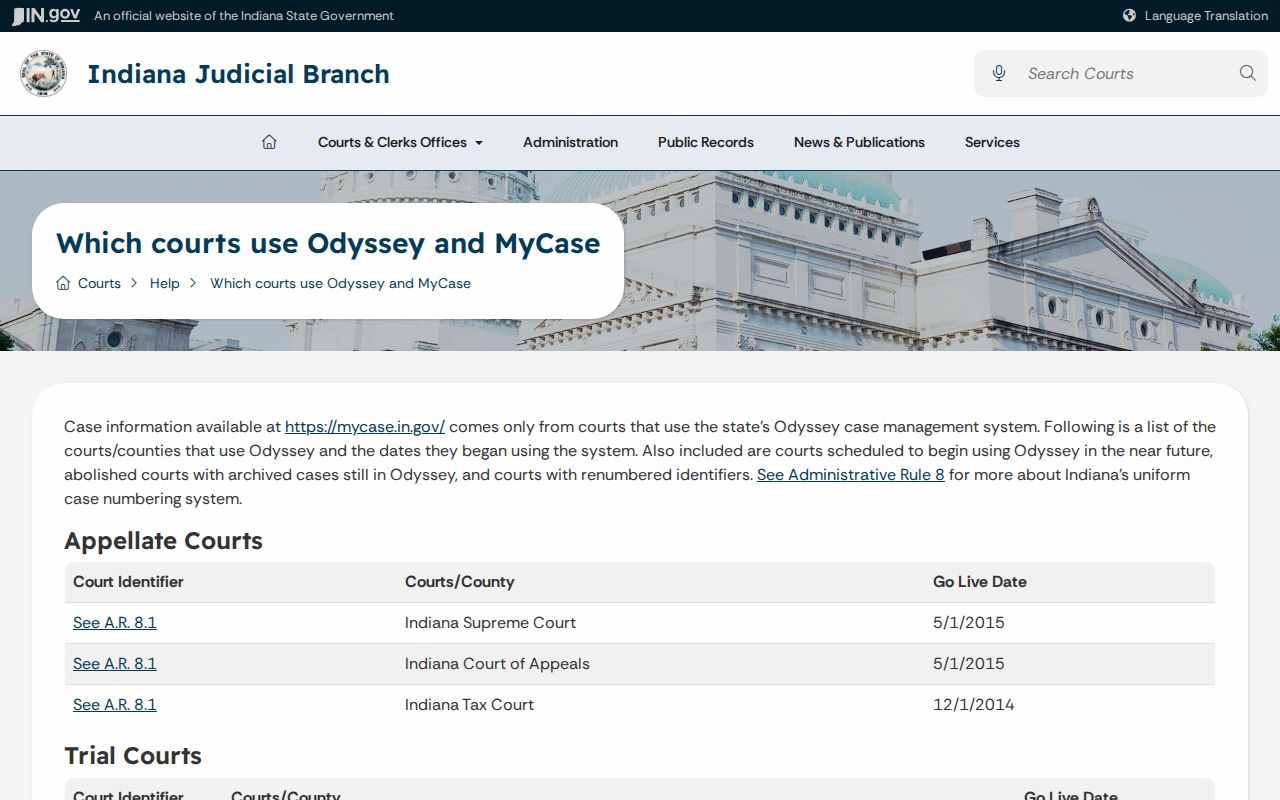
MyCase tracks events well, but the state warns it is not the official court record. Only the filing clerk can certify a copy.
St. Joseph Criminal Filing Volume
Indiana's provisional 2025 statistics show the county's workload without naming anyone. St. Joseph County courts reported 43,785 new filings across all types, 45,409 dispositions, and 45,902 cases pending at the start of 2025. Among new criminal filings were 1,249 F6 cases, 346 F5 cases, 2,755 CM cases, and 2,554 MC cases.
Count the workload, not the people. These administrative totals say nothing about guilt or risk, and one person can appear in several filings. That is why exact court, code, and date filters matter when you work a docket.
The same workbook splits criminal categories instead of lumping everything together. The county rows showed 82 new F4 cases, 51 F3 cases, 33 F2 cases. F1 cases numbered 18. Older felony classes turned up in smaller numbers, and MR logged 15 new filings. Learn those letter-and-number codes. They appear on a current St. Joseph County criminal docket too. Keep the totals in context, though. A filing is one unit of court workload, not a count of convictions. A single case can carry more than one charge.
Access Rules for Criminal Dockets
Indiana Rule 4 opens the courthouse doors: criminal dockets are public by default. Rule 5 then draws the exceptions. It shields juvenile, mental-health, treatment, victim, witness, and personal data. The scope varies. An entire case can be sealed. Or a public CCS can hide just one protected document while the rest stays open. The state handbook linked here walks through where that line sits.
An empty result proves nothing about sealing. It may simply mean the wrong court, a format error, an older file, expungement, or limited online access.
Key rules:
Rule 5 defines excluded court records.
Rule 9 provides a verified extraordinary-access process.
Indiana APRA, IC 5-14-3 governs agency records but does not override court rules.
When a public document is not online, ask the filing clerk directly. Ask in person, by phone, or through the copy process. Older material often sits at the Archives Center, 1140 S Lafayette Boulevard, 574-235-9091. Agency records follow the county APRA form. Transcripts belong to the court reporter. Bulk requests go through OJA under Administrative Rule 9(F), never by scraping MyCase.
The daily county docket is another public route for a setting, but it does not replace the CCS or the court file. A mailed, faxed, or emailed copy request must follow the procedure of the court keeping the case. The Prosecutor's APRA form covers agency records and cannot unlock a sealed filing. Probation and treatment offices are not open criminal-docket archives. Start with MyCase. Confirm the assigned court. Call the right clerk. Then state the exact cause number and the document sought. That order cuts delays. An event can be public while its image is not available remotely. It also keeps the request with the office that can certify the St. Joseph County record.
For a historical file, call Archives before you visit. Some criminal files stay with the Clerk or the originating office. For a transcript, name the hearing and the assigned court so the right reporter can quote the per-page cost. A certified judgment or order goes through the Clerk. Each option answers a different need. The CCS tracks events, and the case file holds available documents. A transcript records spoken proceedings. Certification authenticates a clerk-issued copy.